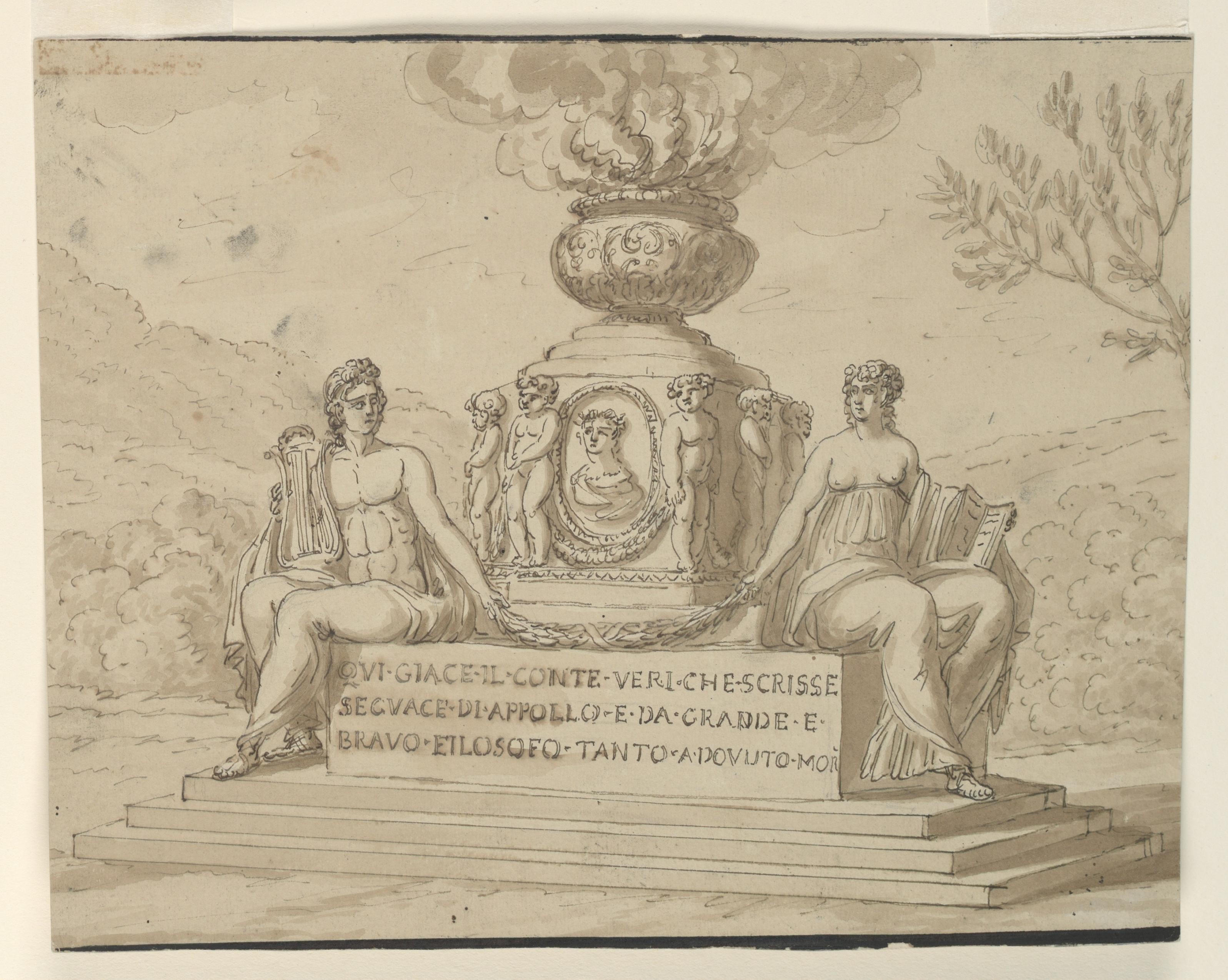
Monumento sepulcral del filósofo conde Alessandro Verri
Un dibujo a tinta parda, pluma y aguada muestra un monumento sepulcral neoclásico: una urna ardiente corona una base cilíndrica con un medallón central y pequeñas figuras, flanqueada por dos mujeres sentadas con paños. Un pedestal escalonado lleva una inscripción en mayúsculas que menciona al conde Verri, sobre un paisaje de colinas con un árbol sin hojas a la derecha.
- Artista
- Desconocido
- Fecha
- 1795–1809
- Técnica
- Pen and brown ink, brush and brown wash, graphite on beige laid paper
- Fuente
- Smithsonian (Cooper Hewitt, Smithsonian Design Museum)
- Tamaño
- 3193 × 2549 px
Dominio público · Smithsonian (Cooper Hewitt, Smithsonian Design Museum) releases this image under CC0 (latest date 1809).
Derechos verificados 2026-11-05 · nivel A · según la fuente: CC0 (Smithsonian Open Access)
Derechos verificados 2026-11-05 · nivel A · según la fuente: CC0 (Smithsonian Open Access)
Crédito (se agradece, no es obligatorio en obras de dominio público): Smithsonian Institution, Cooper Hewitt, Smithsonian Design Museum